Car accidents can leave you shaken, confused, and worried about what comes next. Knowing how to handle the claims process from start to finish can mean money in your pocket. Our Chicago, Illinois car insurance claims guide explains what you need to know, tailored to our state’s unique rules and deadlines.
Understanding Insurance Claims in Illinois After a Car Accident
Illinois uses a fault-based system, meaning whoever caused the crash pays through their insurance. This makes determining blame the primary focus. Illinois requires the following minimum coverage:
- $25,000 per person for injuries
- $50,000 total per accident for injuries
- $20,000 for property damage
- $25,000 per person and $50,000 per accident in uninsured motorist coverage
Your policy includes liability, collision, comprehensive, and uninsured motorist protection. Illinois follows modified comparative negligence (735 ILCS 5/2-1116) for the recovery of damages. You collect money if you’re less than 50% responsible, but your payment drops by your fault percentage. For example, if you’re 30% at fault with $10,000 in damages, you’d get $7,000.
First Steps: What To Do Immediately After a Crash
Always call 911 first. Illinois law requires reporting accidents with injuries, loss of life, or property damage over $1,500 (or $500 if a car lacks insurance). If the police don’t respond, report the accident to the local authorities, sheriff, or state police yourself.
Take photos of everything, including the vehicles, the scene, any injuries, and property damage. Exchange insurance and contact info with other drivers, but don’t admit fault or apologize. Get witness phone numbers, gather evidence promptly, and submit the accident report as soon as possible.
Call your insurance company immediately, even if the crash wasn’t your fault. Skipping this step might violate your policy or Illinois law (625 ILCS 5/11-407), especially if there are injuries or property damage. See a doctor for any pain you have after the accident. Injuries sometimes appear days later, and medical records are necessary to support injury claims.
First-Party vs. Third-Party Car Insurance Claims in Illinois
When you want to know how to file an auto insurance claim in Illinois, it’s important to know that our state has two types of claims. First-party claims happen when you ask your own insurance company for money, such as using collision coverage for your banged-up bumper or comprehensive coverage when a tree falls on your car. These claims usually progress faster since you’re working with your own company.
Third-party claims mean you’re filing against someone else’s insurance because they caused the accident. In Illinois, this is your primary option when another driver hits you. Most car accident cases are settled through back-and-forth communication with insurance companies, with few ending up in court.
When You File With Your Own Insurer
Use your collision coverage for vehicle damage. Comprehensive coverage helps with theft, hail damage, or animal collisions. If another driver has no insurance or too little coverage, your uninsured/underinsured motorist protection steps in.
Watch out for deductibles when using your own insurance. A deductible is the amount you are responsible for before your insurance starts to pay. Deductibles apply to comprehensive and collision coverage but not liability. If you chose a $500 deductible and have $3,000 in damages, you’ll pay $500, and your insurance will cover $2,500. Illinois rules prevent insurers from raising your rates just because you filed a claim that wasn’t your fault.
The Investigation and Settlement Process
For the Illinois car insurance settlement process, times can vary wildly. Simple claims may wrap up in days, but most take two to four weeks. Complex cases with serious injuries, disputed fault, or totaled cars can take months, and personal injury claims may take months or years to settle. Adjusters check police reports, interview parties, assess damage, and review medical records.
Illinois law sets strict deadlines for insurance claim processing. Companies must send claim paperwork within 15 business days, and they must start their investigation and contact you within 21 working days after notification of loss. Claim denials require written explanations within 30 working days. After settlement agreements, Illinois requires payment within 30 days or interest accrues.
What the Insurer Evaluates
Insurance companies evaluate several factors. For car damage, they obtain quotes from approved shops and decide if your car can be fixed. In Illinois, cars are typically totaled when repairs cost 70%-75% of the actual cash value.
For totaled vehicles, insurers must offer fair market value from before the crash. They check similar local cars, mileage, condition, and extras. For injury claims, they review medical bills, treatment history, lost wages, and pain and suffering. Adjusters often inspect cars personally, verify that the damage matches the accident description, and check for preexisting problems.
Common Pitfalls, Denials, and How To Protect Your Rights
In Illinois, Department of Transportation data shows thousands of contested claims each year. Illinois insurers are required to act in good faith, meaning they can’t unreasonably deny claims, postpone investigating, delay processing, or refuse fair settlements. The Illinois Consumer Fraud Act also protects you from questionable sales tactics, lies during claims, and bogus claim denials.
You have two years to file personal injury claims and five years to file for property damage. Your best defenses are good recordkeeping, prompt reporting, and knowing what your policy covers.
Reasons Claims Are Delayed or Denied
Every insurance policy has strict deadlines for filing, sending documents, or appealing denials. If you miss just one deadline, the insurer can automatically reject your claim, regardless of its validity.
If the insurance company thinks you caused the crash, they may deny your claim. Breaking policy provisions, such as driving drunk or letting an unlisted friend borrow your car, can void your coverage. Claims may be denied for:
- Lapsed policies
- Insufficient coverage
- Missing documentation
- Fault arguments
- Policy exclusions
- Suspected fraud
- Preexisting damage
Insurance companies often start with small settlement offers, hoping you’ll take the cash, but their first offer rarely reflects your claim’s true worth. Illinois law bans insurers from lying to claimants, ignoring you, refusing to negotiate fairly, changing your statements, or asking for unnecessary proof.
Partner With American Auto Insurance for Expert Claims Support
Having an expert in your corner makes all the difference when dealing with adjusters, complex policy language, and your rights under Illinois law. We help you document everything properly, negotiate effectively with insurance companies, and avoid common traps that can lead to delays or denials. Unlike big national companies, we offer human help when you need it most.
Don’t try to handle this alone. Call us at 773-286-3500 for help with your claim or to learn how we can help you get every dollar you deserve.
Frequently Asked Questions About Chicago, Illinois Car Insurance Claims
How do car insurance claims work in Illinois?
Illinois uses a fault-based system, so the at-fault driver’s insurance pays for injuries and damage. Claims rely heavily on proving responsibility and following state deadlines.
What insurance coverage is required in Illinois?
Illinois requires minimum coverage of $25,000 per person for injuries, $50,000 per accident for injuries, $20,000 for property damage, and uninsured motorist coverage of $25,000 per person and $50,000 per accident.
What should I do immediately after a car accident in Illinois?
Call 911, report the crash if required, take photos, exchange information without admitting fault, gather witness details, notify your insurer, and seek medical evaluation.
What is comparative negligence in Illinois?
Illinois follows modified comparative negligence. You can recover compensation if you are less than 50 percent at fault, but your award is reduced by your percentage of blame.
What is the difference between first-party and third-party claims?
First-party claims involve using your own insurance coverage. Third-party claims are filed against the at-fault driver’s insurer and are the primary path for injury and property claims.
Will my insurance rates go up if I file a claim?
Illinois rules prohibit insurers from raising your rates for accidents that were not your fault. Fault-based claims may affect premiums depending on your insurer and policy.
How long do car insurance settlements take in Illinois?
Simple claims may resolve in days, while most take two to four weeks. Complex cases with injuries or disputed fault can take months. Insurers must follow deadlines for paperwork, investigation, and payment.
What factors do insurers evaluate when determining claim value?
They review vehicle condition, repair estimates, actual cash value, medical records, lost wages, treatment history, and whether the damage matches the accident.
Why do car insurance claims get delayed or denied?
Missed deadlines, insufficient coverage, policy violations, missing documents, fault disputes, preexisting damage, or suspected fraud can lead to denials or delays.
How long do I have to file a car insurance claim in Illinois?
You have two years to file a personal injury claim and five years for property damage. Missing a deadline may bar you from recovery.
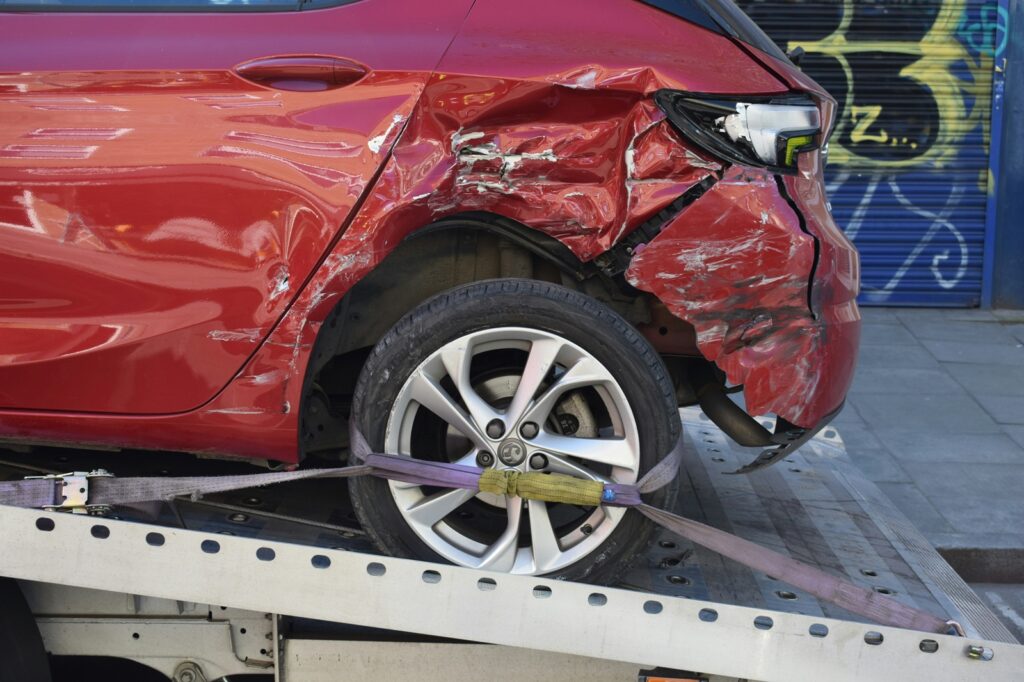
Image of a red car being towed/recovered which was involved in a road traffic collision is licensed with Unsplash License